Why the Solution Is Hidden in a QR Code
The last page of the host''s booklet contains no names. It has two QR codes and one sentence above them: do not scan until everyone has made their accusation.
There is a reason for that, and it is less romantic than you might think.
Paper has a problem
If the solution were printed in the booklet, it would be one page away. The host leafs through the material before the evening to prepare, and their eye catches the name. After that they cannot unsee it. They will spend the whole evening smiling past suspicions they could already dismiss, and sooner or later the guests will notice.
A QR code solves this with remarkably little effort: a human being cannot read it. Not by accident, not out of the corner of an eye, not while turning pages. You have to decide, deliberately, to pick up a phone and scan. That decision is the entire protection.
What it is not
It is not encryption. Anyone determined enough can scan the code in the afternoon and know. We do not stop them and we do not try — that would be like selling a crossword with a padlock on it. It is a lid, not a safe. Lids are enough when everyone at the table wants the same evening.
The code does not open a website
This is the part that surprises most people. The code contains no link. It contains the text itself. When you scan it, the solution appears as a note on your device — no page loads, no server is asked, nothing is recorded.
There is a practical reason: it works without internet. A murder mystery dinner rarely happens where the signal is good. A forest cabin, a holiday house, a cellar with thick walls — in all of those a link would lead nowhere at the decisive moment. Text inside the code leads nowhere by design.
How to scan
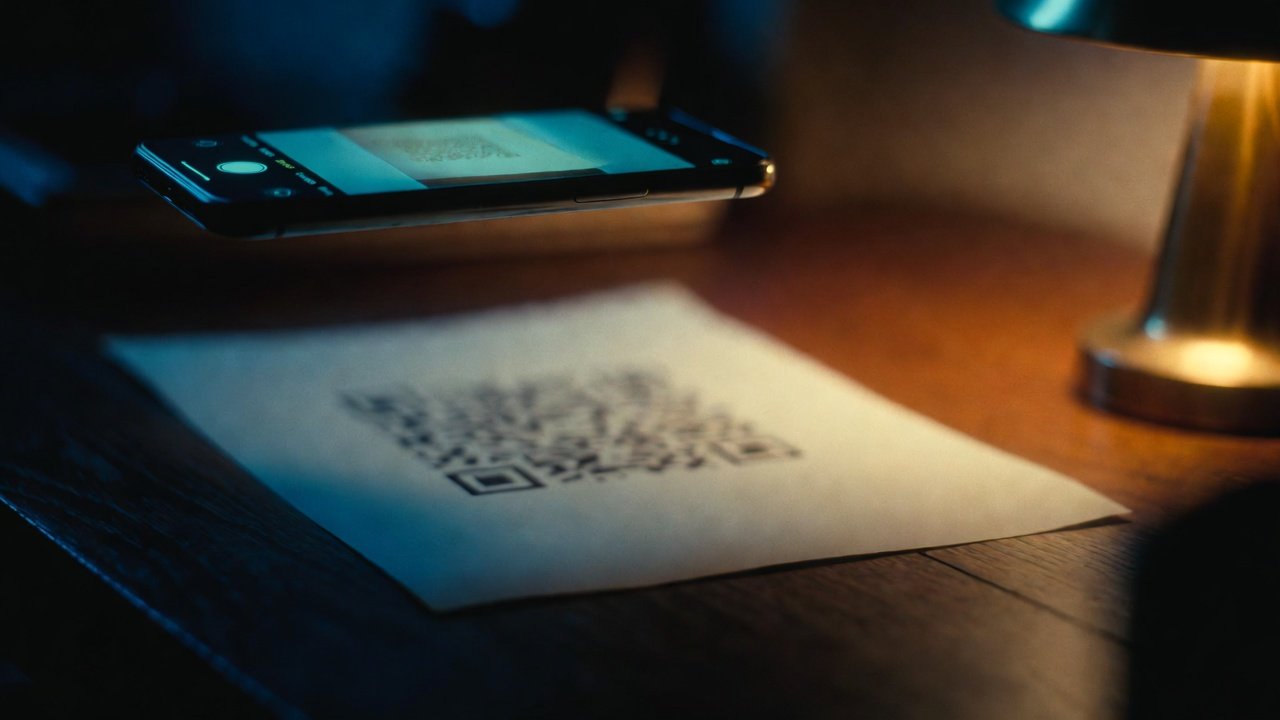
Open your phone''s ordinary camera app and hold it steady, twenty to thirty centimetres above the code. No extra app is needed — iPhones and Android phones have recognised QR codes by themselves for years. After a second or two the text appears — on some devices directly, on others behind a small prompt you tap.
Make sure there is light. The most common reason a code is not recognised is not the code but the candlelight you happen to be sitting in.
Why two codes
The first holds the solution: who did it, and how the evening really went. That one you read aloud.
The second holds the other suspects — one line per person, what made them look guilty and what clears them. You need that one afterwards, because the question always comes: "So why was I under suspicion the whole time?" Every guest gets their answer, and none of them is arbitrary — each points back to the secret that person was actually hiding.
One piece of advice for the host
Do not scan beforehand. You are allowed to guess along. With us the host is not a referee administering the solution — they are simply the one person who reads out the codes, and otherwise a guest like any other. Take that for yourself and you will have a better evening than anyone who scanned in secret that afternoon.